Dumb and Dumber (Ideas)
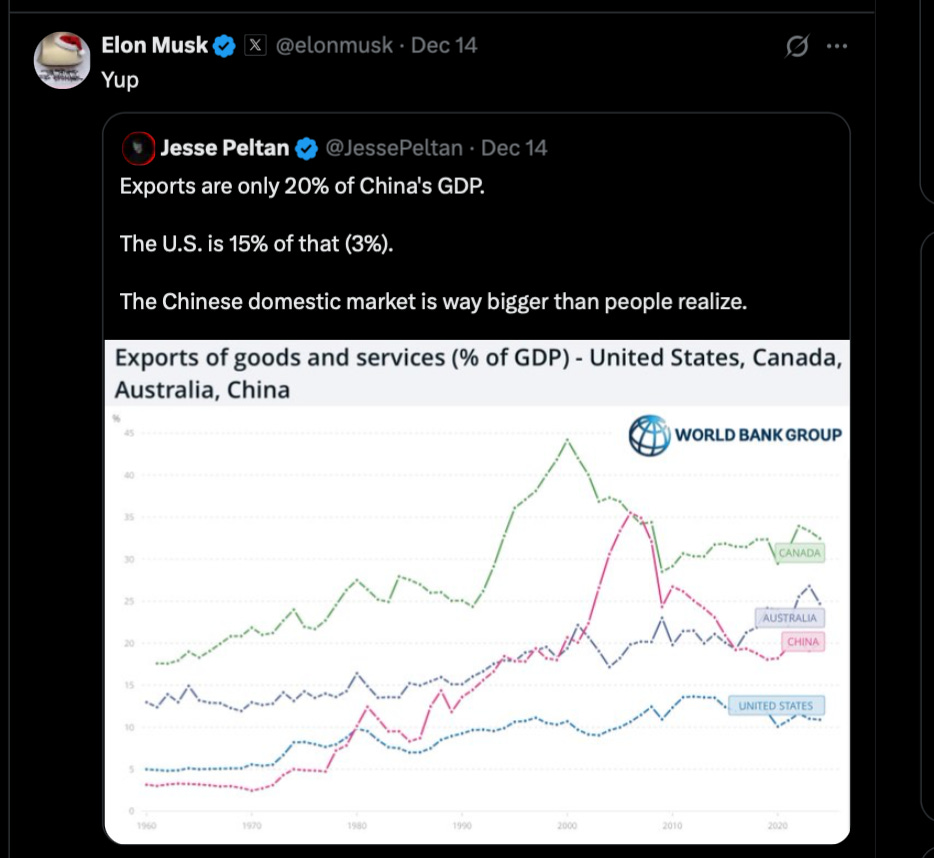
It’s not about GDP composition.
It’s about trade surplus translating into reserves denominated in liquid currency.
China can have a large domestic economy in yuan and still face external constraint because:
~85–90% of global FX transactions involve USD
~58–60% of global reserves are held in USD
The yuan is ~3% of global FX turnover and ~2–3% of global reserves
The yuan is not freely convertible and operates under capital controls
Exports matter not because of GDP share, but because they generate hard-currency inflows (USD, EUR) that fund:
energy imports
food imports
technology inputs
balance-of-payments stability
China’s trade surplus (~$800B–$1T annually) is the primary source of USD accumulation.
Its domestic market settles largely in yuan, which cannot substitute for global settlement liquidity.
That’s why:
A slowdown in exports stresses reserves
Capital controls tighten when surplus weakens
FX intervention increases when USD inflows fall
An economy can be large in local currency terms and still be externally constrained.
GDP measures size.
Reserves measure survivability.
Liquidity currency dominance determines leverage.


