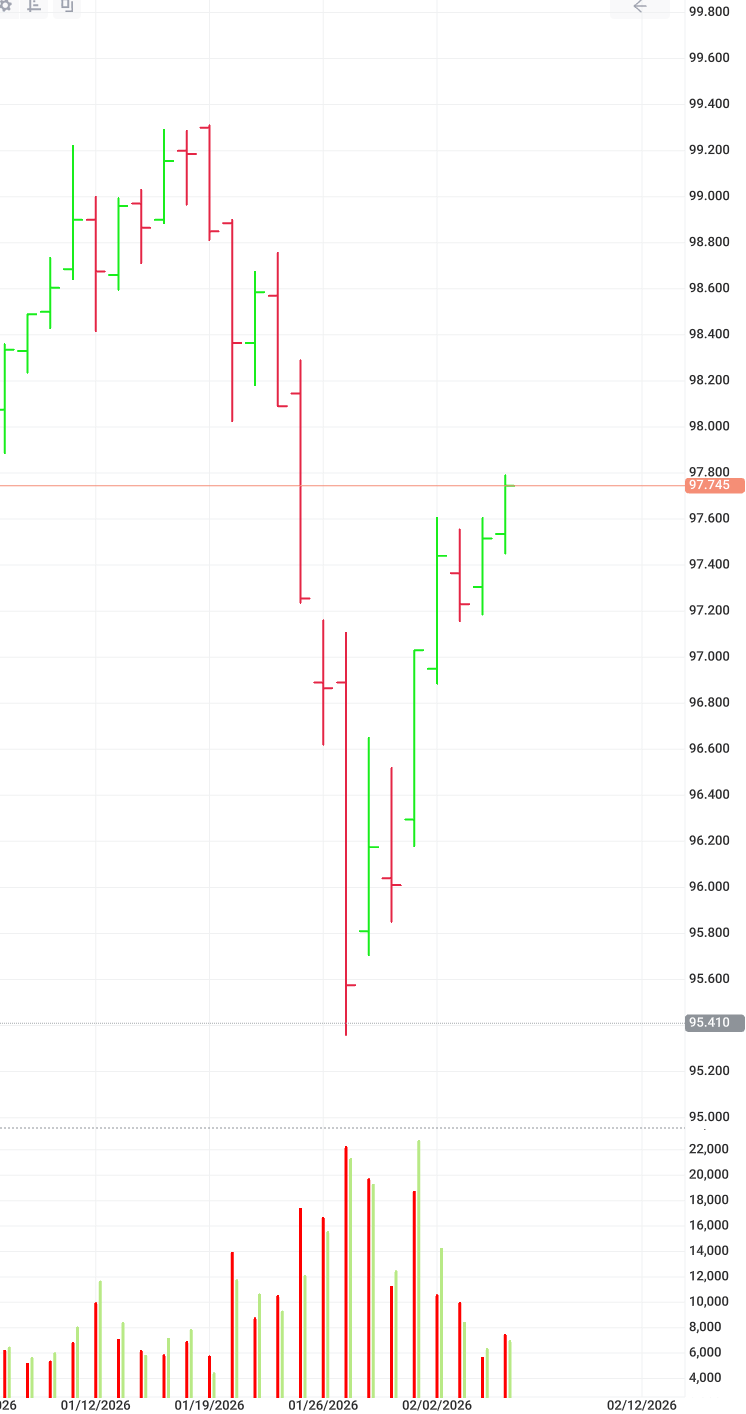
Observe the dollar thesis + ES + GOOG +A/D
Even as yields rise and money becomes structurally more expensive, the tape is quietly sending constructive signals.
You can see it in participation: days where headline indices slip but a large majority of stocks advance, bursts in advancers-versus-decliners, and a growing subset of equities holding near or making all-time highs.
That kind of breadth doesn’t show up in late-cycle euphoria—it shows up during deleveraging with rotation, when capital is being repriced rather than destroyed.
Higher yields are doing their job by flushing excess leverage, but underneath, ownership is broadening and reallocating toward assets and companies that can survive a higher cost of capital.
In that environment, the dollar naturally becomes the primary beneficiary: tighter liquidity, selective risk-taking, and real balance-sheet resilience all reinforce demand for it.
This isn’t a breakdown—it’s a regime shift where strength looks quieter, more internal, and more durable.
Distance from all-time highs isn’t just descriptive.
Distance from all-time highs functions as a proxy for residual balance-sheet damage. Following a carry unwind, assets far from their peaks face a longer recovery path, requiring fresh capital and renewed risk tolerance. The fact that ES remains comparatively close to its highs, while many other macro assets do not, underscores where capital is still being prioritized — and where it is not.
After deleveraging:
assets far from ATHs require time, capital, and renewed risk appetite to recover
assets near ATHs are signaling structural sponsorship or preferred capital treatment
That distance becomes a tell.


