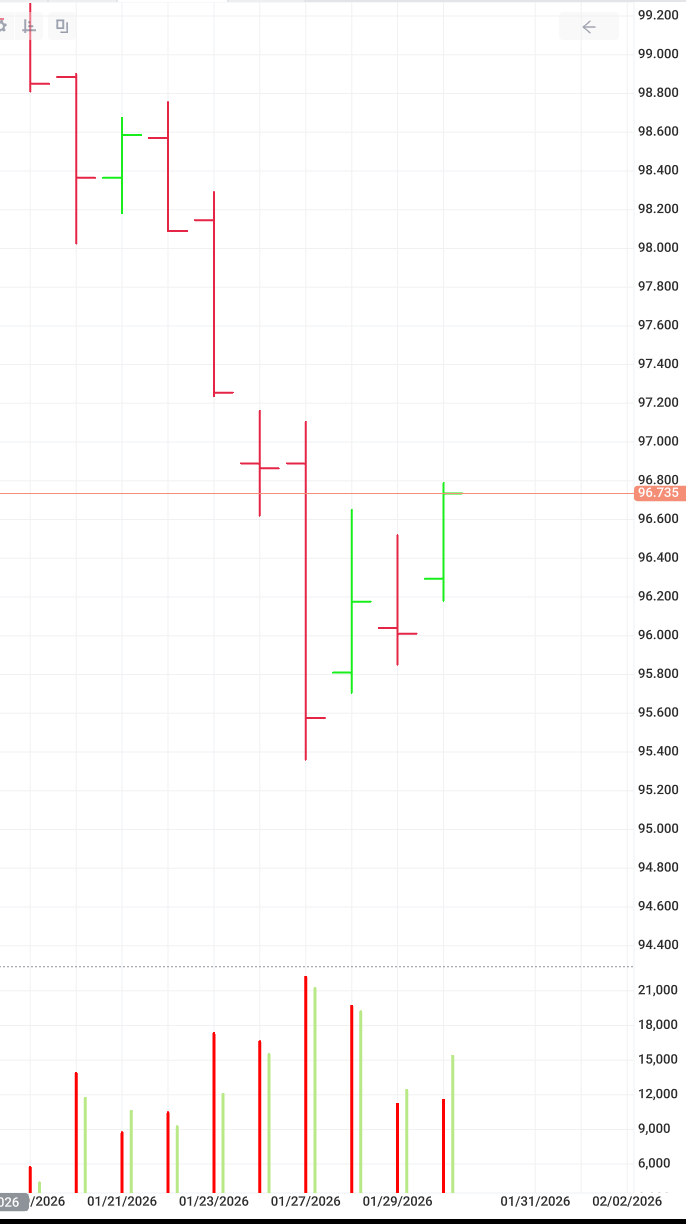
The Dollar Bottomed on Jan 27 — And No Narrative Can Outvote That
Everyone has an opinion about the dollar.
Some people have conspiracies.
Some people have ideology.
Some people have a framework they can talk about for days.
But none of that addresses the only thing that matters:
Why did the dollar bottom on January 27th?
Not “why should it bottom.”
Not “why it eventually bottoms.”
Why did it bottom there — on that day, in that window?
Because markets don’t turn on explanations.
They turn on exhaustion, positioning, and timing.
On Jan 27, the U.S. Dollar Index (DXY) printed a near 4-year low, with an intraday trough around 95.55, then stabilized.
Opinions don’t call the bottom — conditions do.
Why this defeats “abstraction culture”
Abstraction always arrives after the print.
People build beautiful stories once the market has already moved:
“signals were flashing”
“it was obvious”
“risk management mattered more than timing”
Fine. But the truth is simpler:
The best abstractions are downstream of reality.
And if you’re aligned with reality, you don’t need to debate it—because the tape already answered.
That’s the dollar on Jan 27.
Not a thesis.
A timestamp.
A print.
And the print is the only thing that can’t be talked around.


Brilliant take on cutting through the noise. The emphasis on exhaustion and positioning over narratives is something I've seen play out in my own trades where I learned the hard way that the tape doesnt care about my thesis. The Jan 27 timestamp makes it concrete rather than just another prediction that conveniently fits the past.